Non-toxic kitchenUpdated October 2026

A Toxicologist Ranks the 5 Most Common Cooking Utensil Materials, From Most Toxic to Safest

You'll want to change your cooking utensils after reading this. Most of the "safe" ones change the moment they touch a hot pan.

Did you know that a utensil sold as "safe" can still leave important questions unanswered about what touches your food?

Microplastics. Unwanted additives. Adhesives. Surface coatings.

There's no ingredient list on a spatula.

I've been a toxicologist for 25 years. My work is understanding how chemicals get from everyday things into the body, and when those exposures matter.

The kitchen brings those questions together.

Heat. Fat. Acid. Repeated use.

Those conditions can affect how substances move from a food-contact material into your meal.

And while most people know to replace a melted plastic spatula, the next question is harder.

It's the one I get asked more than any other:

"Okay. So what should I use instead?"

Silicone says "food-grade."

Bamboo says "natural."

Wood looks like the obvious answer.

But even wooden utensils aren't created equal.

What separates them is a question almost no label answers: what happens when the utensil gets hot?

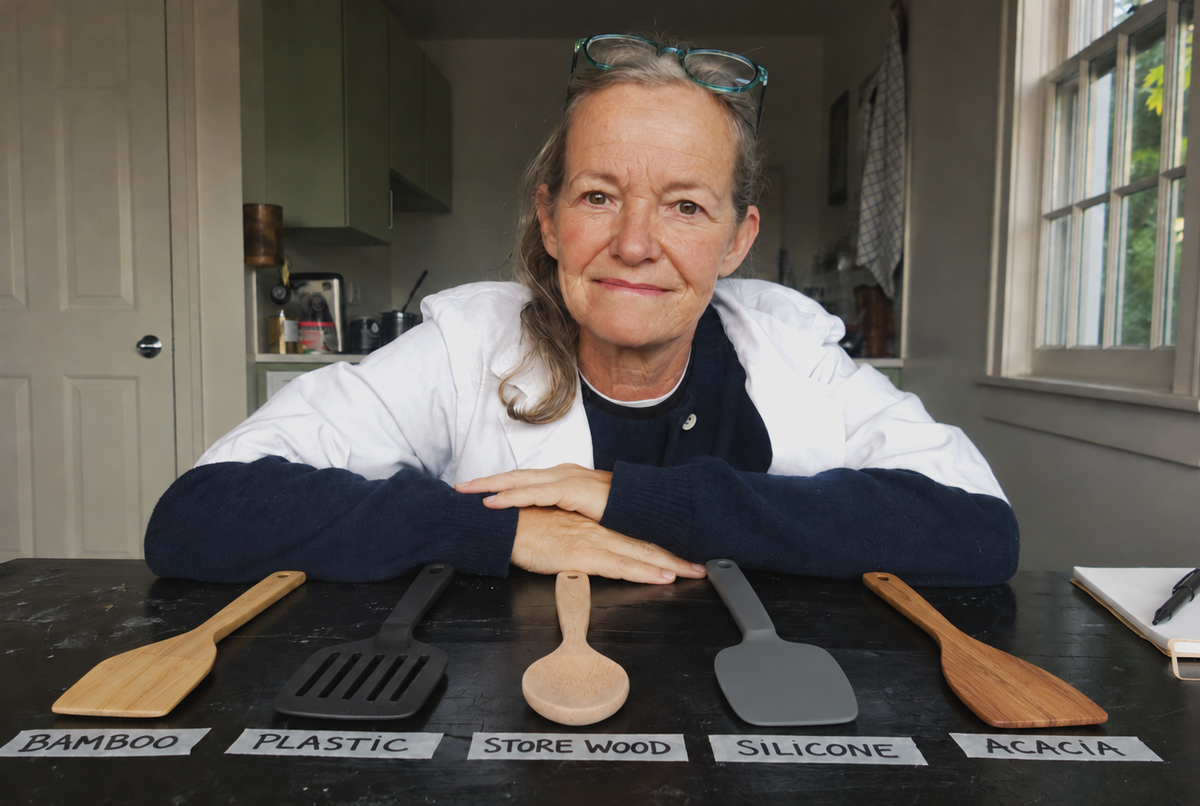
So that's what I tested. I took the five materials almost every American kitchen cooks with, and for each one I looked at what actually touches the food, what heat does to it, and what happens as it wears.

Four of them put something into your food. Only one didn't.

Here's how they rank, starting with the one I'd replace first and ending with the only one I use in my own kitchen.

Jump to #1, the safest ↓
#5Most
toxic
Toxicity

Plastic & Nylon

The one I'd replace first.

If you still cook with a plastic or nylon spatula, take a look at its edge. On most older ones it's thinner than it used to be, frayed at the corners and slightly melted where it rested against the pan.

That missing plastic didn't simply disappear. It came off during cooking, a little at a time, and most of it ended up in the food.

Heat is the reason. In laboratory testing, nylon utensils began releasing plastic compounds into food at around 158°F, far below the temperature of a pan frying eggs.

What worries me most is where that plastic goes afterward. Researchers have now found microplastics in human blood, in the placenta and even in the brain, where one recent study measured roughly a plastic spoon's worth.

And those tiny particles in the body have been linked to a wide range of health problems.

But that isn't the only concern.

Black plastic has recently come under scrutiny for something else. Much of it is made from recycled electronics, and in 2024 researchers found flame retardants in black plastic kitchen utensils, including one the EPA has banned. That chemical has been linked to cancer.

My verdict

The strongest evidence of harm on this list, and the first thing I'd take out of any kitchen.

What heat pulls into your food: The plastic itself, plus flame retardants
#4Synthetic Toxicity

Silicone

It looks perfect. That's the problem.

Silicone has become a lot of people's safe choice, and I understand why. It's soft, it's gentle on pans and it doesn't feel like plastic.

It is still a synthetic material, though, and its quality depends entirely on how it was made. When I pinched and twisted some of the cheaper ones, the bend turned white. That's usually a sign of filler added to cut costs, and that filler is part of the surface touching your food.

Heat is where the real question lies. Hot silicone can release compounds called siloxanes, and researchers have measured them moving out of silicone and into food.

Studies have linked one of them, D4, to fertility problems, and it can act like estrogen in the body. In my field, a compound that behaves like estrogen is one you keep away from food wherever you can, especially food you cook for children.

What makes silicone harder to judge is that it gives you no warning. A plastic spatula shows its wear. A silicone one can look brand new for years while it sits in your hot food.

My verdict

It doesn't shed like plastic. But it's still a synthetic in your hot food, and you'll never see what's coming off it.

What heat pulls into your food: Siloxanes, filler
#3Held together
by glue
Toxicity

Bamboo

It isn't even wood.

Bamboo seems like the most natural choice there is. It grows quickly, it's plant-based and it's usually sold as the eco-friendly option.

But bamboo is a grass, not a wood, and you can't carve a spoon out of a hollow grass stem. To make a utensil, manufacturers shred it into strips and press those strips back together with glue, most often a formaldehyde-based one. When I cut a bamboo spatula in half, I could see every strip and every glue line between them.

That glue is the weak point, because heat and water are exactly what break it down. Every steaming pot and every hot wash loosens it a little more, until the utensil starts to split along those lines, and each split exposes more glue to your food.

That matters because of what the glue contains. The National Toxicology Program lists formaldehyde as a known human carcinogen, and in late 2024 the EPA concluded it poses an unreasonable risk to human health.

My verdict

It's mostly plant fiber, which is better than a synthetic. But it's held together by glue all the way through.

What heat pulls into your food: Formaldehyde-based glue
#2The
surprise
Toxicity

Glued & Lacquered Wood

Wood isn't always just wood.

Wood is where a lot of careful cooks put their trust. It's natural, it's been used in kitchens for centuries, and a wooden set feels like the problem is solved.

The trouble is that "wood" on a label only tells you what a utensil started as. It doesn't tell you how it was made. Many inexpensive sets, acacia ones included, aren't carved from a single piece. They're assembled from offcuts held together with the same kind of glue used in bamboo, then sealed with a glossy lacquer so they look good on the shelf.

That lacquer was never designed to be cooked in.

And once a glue joint begins to open, water gets in behind it. That's why the dark line along the seam of an old wooden spoon is so often mold.

My verdict

Wood is the right direction, but only if the wood is the only thing touching your food. If a wooden utensil shines, it has been coated.

What heat pulls into your food: Glue and lacquer

The standard I use

Most "safe utensil" lists online are incomplete, sponsored, or both. So here's the standard I hold every utensil to. Each rule comes directly from one of the failures above:

  1. Nothing synthetic touching hot food.That rules out plastic and silicone.
  2. No glue.That rules out bamboo and most cheap wooden sets.
  3. No lacquer. Natural oils only.That rules out shiny wood.
  4. Nothing heat can change.

A utensil can't release what it doesn't contain.

Only one kind of utensil passes all four.

#1The
safest
Toxicity

One-Piece Small-Leaf Acacia

One solid block. Nothing added. Nothing to melt.

The one utensil that passes all four is also the simplest: a head and handle carved from a single block of small-leaf acacia, with no joint between them. There's no plastic, no silicone, no glue and no lacquer. The only thing on it is a rub of plant oil and beeswax.

That simplicity is the whole point. When it meets heat, there's nothing to soften, nothing to loosen and nothing to break down, because nothing was added in the first place.

The wood itself matters too. Small-leaf acacia is a dense, hard, naturally oily hardwood. Its density means it doesn't swell, split or go soft in hot water. Its hardness means it can be carved thin enough to slide under a fried egg. And its natural oils help it dry quickly without needing a coating.

Because it has no seams, there's also nowhere for water or bacteria to collect. When researchers at the University of Wisconsin compared wood with plastic, they recovered far fewer bacteria from the wood.

The one trade-off is that it doesn't belong in the dishwasher. Hand wash it, dry it, and give it a little oil now and then.

My verdict

The only kind of utensil I let near my family's food.

What heat pulls into your food: Nothing

The hard part is finding one that's actually made this way. I'll come to that right after the ranking.

And the winner is…

RankMaterialWhat heat pulls into your food
#5Plastic & nylonThe plastic itself, plus flame retardants
#4SiliconeSiloxanes, filler
#3BambooFormaldehyde-based glue
#2Glued & lacquered woodGlue and lacquer
#1One-piece small-leaf acaciaNothing

Finding a set that's actually made this way

Carving from a solid block is slow and wastes a lot of wood. So most acacia utensils are glued together from offcuts and lacquered over the seams, which puts them right back at #2.

I read more than a hundred product pages and contacted a long list of sellers and suppliers, asking each of them the same three questions. Is every piece carved from one block? Is there glue anywhere? What exactly is the finish?

Most couldn't answer. One could.

My pick: Properware's small-leaf acacia set

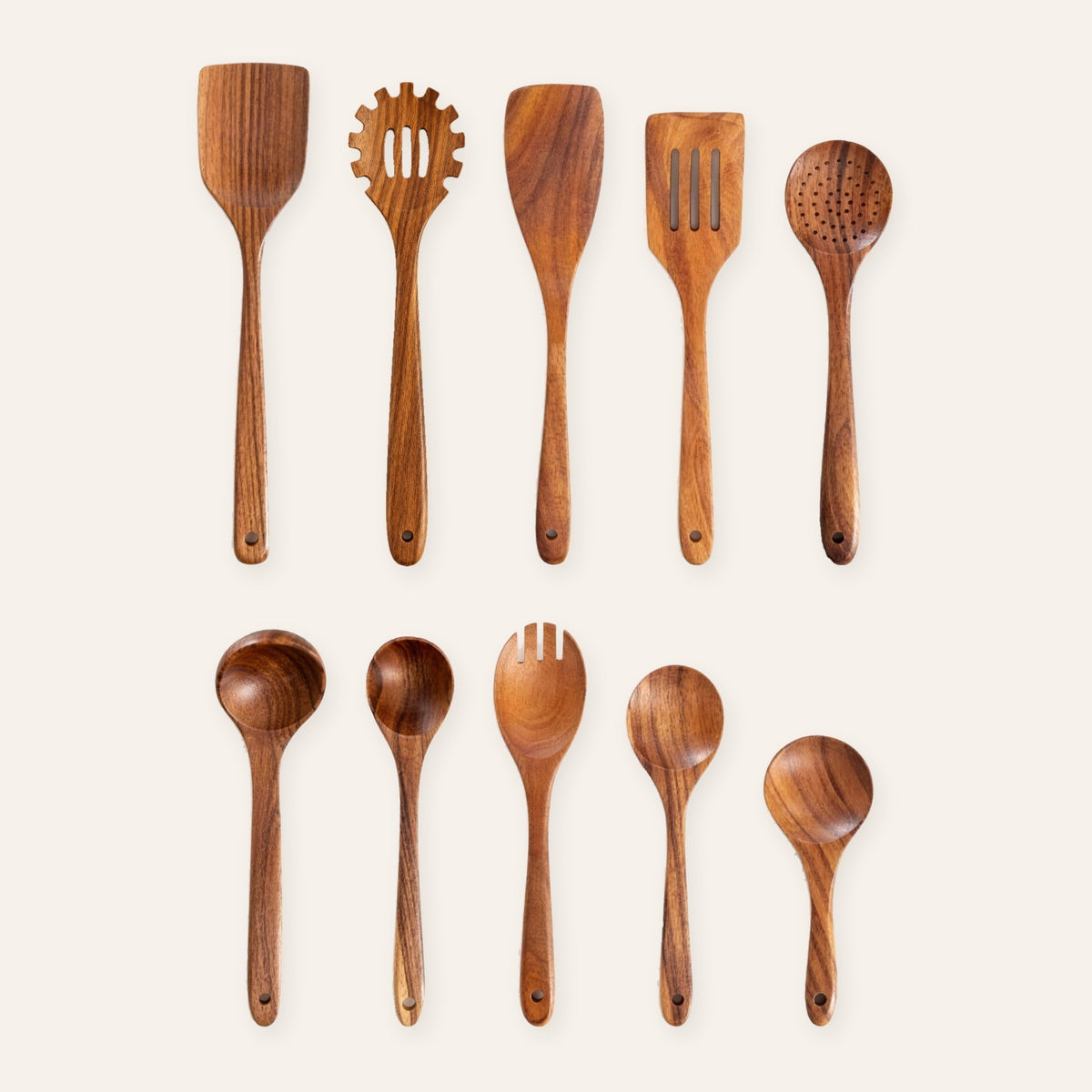
10-piece teak utensil set laid out

Why it's my pick. Every piece is carved from one block of small-leaf acacia. There's no glue and no lacquer, and the only finish is plant oil and beeswax. They were the only seller who could answer all three questions.

How I checked. I cut one of their spatulas in half, the same way I cut the bamboo. The grain runs unbroken from edge to edge.

What I use it for. It's what I cook with at home every day, and the set I trust for my whole family.

Worth knowing. It costs more than a store-bought set, it needs hand washing, and it's only sold on their own website.

Update (October 16)

Properware is running its fall sale right now. Because every piece is carved from a single block of small-leaf acacia, they can only make small batches, and when a batch sells out there's a wait for the next one. Only on their official website. Not on Amazon, and not in stores.

15 Comments

  1. Karen Mitchell says:

    I used to have plastic ones. Checked the spatula I’ve been cooking with for years and threw that shit away immediately. The edge was literally peeling.

    Reply
  2. Dr. Linda HartwellAuthor says:

    A visibly peeling or melted utensil is worth replacing. Check the construction and finish when choosing what comes next, too.

    Reply
  3. Susan Reynolds says:

    The wooden ones at #2 were the surprise for me. I thought buying wood was the whole point. Never even considered what they finish it with.

    Reply
  4. Dr. Linda HartwellAuthor says:

    That’s why I included that distinction. “Wood” tells you the material, but it doesn’t tell you whether there’s glue or what finish was applied.

    Reply
  5. Patricia Collins says:

    The picture of the cut spatula helped. Much easier to understand what “one piece” means when you can actually see inside it.

    Reply
  6. Deborah Hayes says:

    My grandmother cooked with the same wooden spoons for as long as I can remember. Funny how we keep coming back to the things they used.

    Reply
  7. Nancy Brooks says:

    Mine too 😂 She had one spoon she wouldn’t let anyone else touch.

    Reply
  8. Michelle Parker says:

    Which set includes the spatula in the egg picture? That’s the piece I’d use every morning.

    Reply
  9. Dr. Linda HartwellAuthor says:

    The spatula comes in all three sets, including the 4-piece.

    Reply
  10. Janet Sullivan says:

    I appreciate you mentioning the care. I’d rather know how to look after something properly than be told it needs absolutely nothing.

    Reply
  11. Dr. Linda HartwellAuthor says:

    It’s straightforward: hand wash, dry right away, and apply a little food-safe oil when the wood looks dry. No soaking or dishwasher.

    Reply
  12. Diane Foster says:

    The 7-piece sounds like the right size for me. Mostly eggs, soups and pasta in this house.

    Reply
  13. Barbara Lawson says:

    Sending this to my husband. We’ve been meaning to replace the random collection in our utensil drawer for months.

    Reply
  14. Sandra Bennett says:

    Can you use these with non-stick pans too?

    Reply
  15. Dr. Linda HartwellAuthor says:

    Yes, Properware lists them as suitable for non-stick, stainless steel and cast iron.

    Reply

Leave a Reply

Your email address will not be published. Comments appear after moderation.

Sources

  • Polyamide (nylon) kitchen utensils, oligomer migration above 70°C (158°F), German Federal Institute for Risk Assessment (BfR), 2019
  • Microplastics in human blood, Leslie et al., Environment International, 2022
  • Microplastics in human placenta, Ragusa et al., Environment International, 2021
  • Microplastics in human brains (decedent brain samples), University of New Mexico, Nature Medicine, 2025
  • Flame retardants in black plastic household products, Toxic-Free Future, Chemosphere, 2024 (corrected 2025)
  • EPA rule restricting decaBDE under TSCA, 2021; EPA IRIS assessment of decaBDE
  • Migration of siloxanes from silicone kitchenware into food, Swiss Federal Food Safety and Veterinary Office
  • Reproductive toxicity and estrogenic activity of D4 (octamethylcyclotetrasiloxane) in rodent studies
  • Formaldehyde, National Toxicology Program, Report on Carcinogens
  • EPA final TSCA risk evaluation for formaldehyde, December 2024
  • Ak & Cliver, wood vs plastic cutting surfaces and bacterial recovery, University of Wisconsin, Journal of Food Protection, 1994

Advertorial. This article is sponsored by Properware. Dr. Linda Hartwell works with Properware. Wooden utensils need hand washing and the occasional oiling. Prices and offers can change; the product page shows the current ones.

© Non-toxic Kitchen Guide